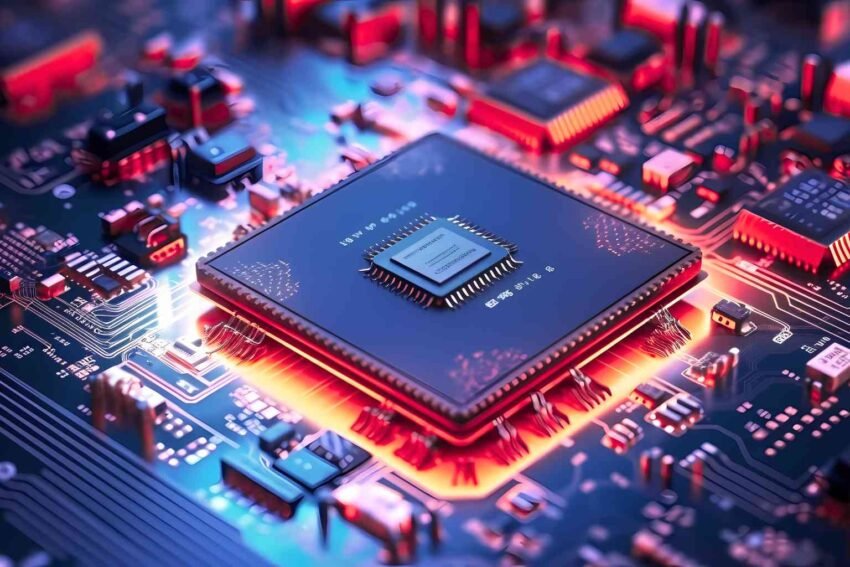
Your average computer chip is linear and orderly when it comes to processing data. The human brain works very differently. It can handle enormous data sets simultaneously, learn from experience, even operate on almost no power. Neuromorphic chips are attempting to replicate this brain-like architecture and operation. The aim is to allow more efficient, adaptable and intelligent computing.
Neuromorphic systems aren’t designed after traditional computing systems, but rather seek to emulate how neurons and synapses work together in the brain.
1. What Are Neuromorphic Chips
Neuromorphic chips is a shorthand for what we call specialized processing designed to approximate the human brain. They carry out parallel information processing by means of artificial neurons and synapses. This structure allows them to perform higher level tasks, such as pattern recognition and sensory processing more easily.
They rely not only on serial computation as a classical CPU does.
2. How the Brain Sends Messages
The human brain contains billions of neurons linked by synapses. These are neurons, and they talk to each other by little bursts of electricity known as spikes. Data is running in parallel and many things happen at the same time.
To model this parallel, event-based processing, neuromorphic chips are developed.
3. Spiking Neural Networks
Spiking Neural Networks are one of the key technologies of neuromorphic chips. Far from always sending out signals, as real neurons do, the artificial neurons can sit idly until they receive a strong enough jolt. “Everybody knows this is how it works in a biological neuron.
By the event-based processing, Allele-Counting merely consumes extremely small portion of power.
4. Energy Efficiency Advantages
The brain is very, very energy efficient, particularly relative to what we currently think of when we think of computers doing these kinds of tasks. Analog neuromorphic chips are designed to be similarly efficient. They help to conserve power and reduce heat generation by only powering up circuits when they are being used.
This makes them ideal for low-power devices and edge device.
5. Key Characteristics of Neuromorphic Systems
Neuromorphic chips have unique features:
- Parallel data processing
- Event-driven communication
- Adaptive learning capabilities
- Low energy consumption
- Real-time sensory processing
These are different from previous processors.
6. Applications in Artificial Intelligence
AI tasks including image recognition, speech and robotics have been targeted as potential applications for neuromorphic chips. They quickly responds and highly efficient owing to their neuromorphic nature.
They are highly useful in real time situations.
7. Contribution in Robotics and Autonomous Systems
Robots and autonomous systems have to take such time constrained decisions under energy constraints as well. Neuromorphic chips enable faster processing of sensory input and more rapid responses in movement. It results in faster, energetically efficient reactions.
These types of processing models may be applied in the field of autonomous driving.
8. Challenges in Neuromorphic Development
But, despite strides, there is still a long way to go before neuromorphic technology makes it into practical use:
- Complex hardware design
- Limited development tools
- Difficulty scaling production
- Compatibility with existing software
- Need for new programming approaches
These challenges slow widespread adoption.
9. Differences From Traditional AI Hardware
Traditional AI hardware generally refers to GPUs and cloud co-processing. Neuromorphic chips are built to perform distributed brain-style processing. Not big data centers, but literally smarts embedded directly inside small things.
This would be a move to allow expansion of edge computing.
10. The Future of Brain-Inspired Computing
The next generation of intelligent machines is at the forefront of artificial intelligence research, with computing performance that can challenge biological systems. This type of chips may, as further research continues, also be the foundation for smart tools, wearable tech, health monitors and other advanced robotics.
And by copying the human brain more closely, future machines could be far more adaptable, efficient and responsive.
Key Takeaways
- How neuromorphic chips work The architecture for a neuromorphic chip is inspired by how the human brain operates.
- They make use of neuro-inspired artificial neurons and spiking neural networks.
- The ability to save energy is one big advantage.
- Applications include robotics, AI and edge computing.
- However, problems come up when you want to scale and program them.
FAQs:
Q1. What is a neuromorphic chip?
It is a brain-inspired processor, modeled after how neurons process information.
Q2. What makes it so special from a regular processor?
Its parallel, event-driven data operations differ from serial based operations.
Q3. Why are neuromorphic chips so efficient?
Because they only activate when needed, just like biological neurons.
Q4. Where are neuromorphic chips used?
In robotics, AI systems and low-power edge devices.
Q5. Will new-school CPUs be replaced by neuromorphic processors?
They may support traditional processors, not fully replace them.